
Mental Blocks in Sports: Why Athletes Freeze and How to Fix It
Why skilled athletes suddenly freeze, balk, or get the twisties.
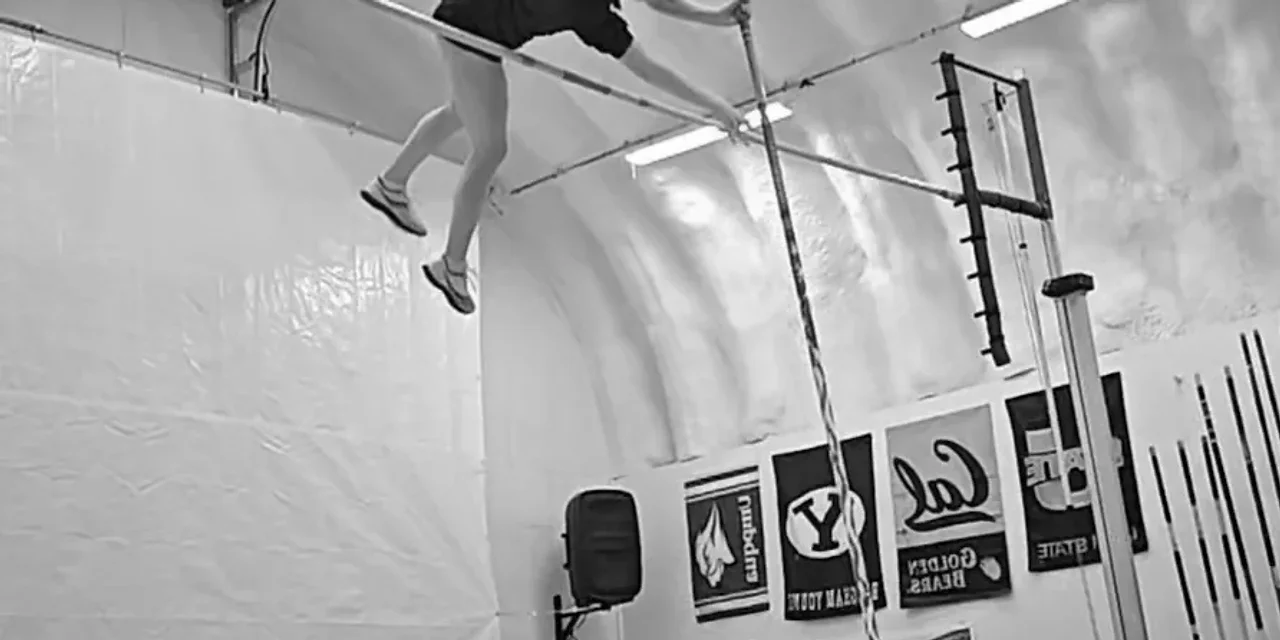
A gymnast stands at the end of the beam and cannot make herself throw a back handspring she has done a thousand times. A diver reaches the end of the board and balks. A climber freezes two bolts above her last clip, unable to make a move she would make without thinking a foot off the ground. A pole vaulter runs the full approach, gets to the box, and runs straight through.
Everyone watching asks the same question: Why won't they just go? The athlete is asking it too, more painfully than anyone else: I know I can, so why can't I?
I have spent more than four decades in pole vault. I was a vaulter, an NCAA All-American, a high school coach, and the father of vaulters, and I have watched this happen to athletes of every level, including myself. In 2026, neuroscientist Heather Berlin gave a TED talk called "How to rewire your brain — and find your flow." It explains, better than anything I have heard, what is going on inside an athlete who is stuck. Her central point fits sport almost perfectly: "Once you've trained in order to perform at your best, you have to stop trying so hard to perform."
This article puts her ideas together with what I have learned rebuilding athletes. It covers:
- What a mental block is, and what it looks like in different sports
- What is happening in the brain when an athlete freezes
- Why "just go for it" usually makes things worse
- Five practical ways to rebuild trust and get back to flow
- Specific guidance for coaches and for parents
What a mental block actually is
A mental block is when an athlete who is physically able suddenly becomes psychologically unable to perform a skill freely. It can show up as hesitation, balking, freezing, loss of rhythm, outright refusal, or a skill that still happens but in a guarded, distorted way.
Blocks are most common in sports that combine three things: real physical risk, fast or committed movement that can't be stopped halfway, and skills that were learned until they became automatic. In those sports, the moment of commitment is where the brain's alarm system has the most to say.
Sport | What the block looks like | The "point of no return" |
|---|---|---|
Gymnastics and trampoline | Balking backward skills; "the twisties," where an athlete loses track of where they are mid-air | Leaving the floor, beam, or vault table |
Diving and cheer tumbling | Balks at the end of the board; can't start a back tuck that was routine last week | Takeoff |
Pole vault | Run-throughs, aborting at the box, late plants, protective last steps | The plant and takeoff |
Rock climbing | Freezing above the last bolt, downclimbing, grabbing the quickdraw instead of committing to a move | A move where a fall is possible |
Wrestling and judo | Not shooting, or not attempting a throw after being taken down or injured | Committing to the attack |
High jump, hurdles, freestyle skiing, BMX | Stutter-stepping, braking into the jump, bailing on a trick | Takeoff |
Baseball, golf, darts (the "yips") | Sudden loss of a simple, automatic motion: a routine throw, a short putt | The release |
The twisties became famous in 2021, when Simone Biles withdrew from Olympic events. She described being unable to "comprehend how to twist" and called it "honestly petrifying" to try a skill when her mind and body were not in sync. One of the most decorated athletes in history was blocked. That alone should end the idea that blocks happen to the weak.
Baseball players have a name for their version, "Steve Blass disease," after the Pittsburgh pitcher who suddenly lost his ability to throw strikes in the 1970s. The yips look different from a balk on a beam, since nothing dangerous is happening. That is a useful clue. The threat the brain responds to is not always physical. Sometimes it is failure, embarrassment, or letting people down.
What a block is not
Not every bad day is a mental block. In my book How to Build Confidence in Pole Vaulters, I use what I call the Rule of Thirds: roughly a third of practices feel great, a third are average, and a third don't go well. That is normal. A rough day should be labeled for what it is, "just one of those days," before anyone builds a bigger story around it.
It becomes a block when the bad third starts taking over: when the fear outlasts the bad day, when the athlete starts dreading practice, and when avoidance becomes the pattern rather than the exception.
What is happening in the brain
You do not need a neuroscience degree to help a blocked athlete. But a simple picture of the brain changes how athletes, coaches, and parents react, and the reaction is often the difference between a block that lasts a week and one that lasts a season.
The alarm: the amygdala
Deep in the brain's emotional system is the amygdala, the threat detector. Its job is to notice danger fast and get the body ready before conscious thought catches up. It learns quickly and forgets slowly. One hard crash, a near-miss, an injury, or even a frightening jump that went fine can teach it that this movement, in this place, is dangerous.
Once that prediction is in place, the alarm fires before the skill begins: at the end of the runway, at the edge of the board, at the last bolt. Heart rate rises, muscles brace, and the body puts on the brakes. That is not weakness. It is the brain doing its job too well.
The brake and the accelerator
Berlin's research looks at how two systems interact. She calls the prefrontal cortex "the brain's brake pedal." It is the planner and the editor, the voice that says wait. The deeper limbic system, home of emotion, reward, and drive, is "the accelerator." She gives them memorable names: your inner Spock (logical and disciplined) and your inner Keith Richards (instinct and impulse).
"Too much Spock, you freeze. Too much Keith, you act before you think. And the key isn't choosing one. It's learning to tune the dial between them." — Heather Berlin
A blocked athlete is stuck with the brake slammed down. The alarm is sounding, and the conscious, analyzing, self-monitoring brain has taken over a skill it was never meant to run.
Where skills actually live
This is the key point. A well-trained skill is not stored in the conscious, thinking part of the brain. Berlin explains that expert movement "lives deep in circuits, linking the motor cortex, basal ganglia and cerebellum." A pianist does not think move my left pinky. A surgeon does not consciously guide every cut. A vaulter in rhythm does not count every step and think through the plant.
"When they enter flow, control is still there. It's just automated. Letting go doesn't mean chaos. It means trusting the control you've already built."
Research on freestyle rappers shows what this looks like. In a 2012 fMRI study, activity in the dorsolateral prefrontal cortex, part of the brain's monitoring and editing system, dropped while rappers improvised compared with when they recited memorized lyrics. In Berlin's words, "their inner Spock mutes." Flow is not the absence of skill. It is skill running without interference.
Why thinking about the movement makes it worse
Sport psychologists call this explicit monitoring, and it is one of the best-supported explanations for choking under pressure. When pressure or fear makes an athlete consciously attend to a movement that is normally automatic, the movement gets slower, stiffer, and less coordinated. The conscious brain is trying to run a program it does not have the code for.
The research on attention backs this up. A 2021 meta-analysis in Psychological Bulletin pooled 73 studies on performance and 40 on learning. It found that focusing on the effect of a movement (an external focus, like "drive the pole up" or "push the floor away") beats focusing on body parts (an internal focus, like "bend your elbow") across ages and skill levels. One study of practice instructions found that body-focused instructions given early in learning led to worse performance later under pressure. External-focus instructions did not cause that breakdown.
Berlin puts it simply: "The minute you become too self-aware, you activate parts of your prefrontal cortex and fall out of flow." A gymnast thinking what if I get lost?, a wrestler thinking what if he counters?, and a vaulter thinking what are the coaches thinking? have all pulled the skill out of the circuits that know how to do it.
The control paradox: why forcing it backfires
When something feels unsafe, people grip harder. Berlin opens her talk with this: "Humans are hardwired to crave control because uncertainty feels like a threat." Then she adds the paradox: "The tighter we grip, the more anxious, rigid and fearful we become."
That is exactly what happens to a blocked athlete and the adults around them. The athlete tries to control every step. The coach adds more cues. The parent adds more encouragement. Everyone increases the pressure, and the brake goes down harder.
The fear loop
Fear in sport rarely shows up once and leaves. It becomes a loop:
- The athlete anticipates the problem before the attempt.
- Anticipation creates tension, which alters rhythm, posture, and timing.
- The altered movement produces a bad rep: a balk, a run-through, a scary landing.
- The bad rep confirms the fear and teaches the alarm that it was right.
- The next attempt starts with that memory, not a clean slate.

The same mechanism runs in both directions. The rebuild in the next sections is about deliberately moving an athlete from the left loop to the right one.
Practice structure feeds this loop more than most coaches realize. In pole vault, practices slowly drift into miniature meets: longer runs, bigger poles, a higher bar, until the athlete is taking jump after jump at the edge of their ability. Gymnastics, diving, and climbing have the same trap: always attempting the hardest version, always ending on the scary one. When the last feeling of the day is panic or failure, the athlete is no longer training. They are rehearsing the problem. The body remembers how practice ends.
Why "just go for it" doesn't work
To the adult, "just go for it" means trust yourself, stop overthinking. To the blocked athlete, it lands as pressure and accusation. They already know they need to go for it. That is the source of the pain. What they don't know is how to restore commitment when the body is sending warning signals the mind cannot simply overrule.
Yelling sometimes seems to work. The athlete throws one skill out of pride or desperation, and everyone thinks it's fixed. But that rep may come at a hidden cost. The athlete now links the skill not only with fear but with humiliation. A strategy that forces a moment does not necessarily build resilience.
Courage and suppression are not the same thing. Courage says, "I feel fear, and I can move with it in a manageable way." Suppression says, "I'm not allowed to feel fear." In the short term, suppression looks like toughness. In the long term, it tends to come out as panic, avoidance, or burnout. Many of the athletes most vulnerable to blocks are the driven, conscientious ones, because they care so much.
Five ways to break through
Confidence rarely comes back because of words alone. It comes back through experiences: real, repeatable successes the athlete can feel in their body. Everything below is built on that idea. Berlin's four practices for "losing control on purpose" fit almost exactly with what I have seen work on the runway.
1. Shrink the skill until the brain can't argue
Berlin describes a patient with severe panic who had avoided elevators for years. She started by riding one floor and stepping out. Over time, "her brain learned discomfort isn't danger," and eventually she could ride to her new 33rd-floor apartment.
That is graded exposure, the same principle behind exposure therapy, and it is the backbone of every good athletic rebuild. The alarm doesn't respond to logic. It responds to experience. So give it a version of the skill small enough to succeed at, repeat it until it's boring, then take one step up.
Sport | Start here | Then | Build toward |
|---|---|---|---|
Pole vault | Short run, softer pole, low bar or bungee | Add a stride, then a pole, only after consistent jumps | Full approach at an opening height, repeated in rounds |
Gymnastics | Skill into a pit or onto a mat stack; spotted; on the floor before the beam | Low beam, then reduce spotting | Full skill on the apparatus, then in a routine |
Diving | Lead-ups from the side of the pool or the 1-meter board | Same dive, one board height up | Competition height, then the full list |
Climbing | Small, clean falls just above a bolt with an experienced belayer | Slightly bigger falls, then falls from mid-move | Committing to moves on routes well within your grade |
Wrestling | Drilling shots on a cooperative partner | Live situations at reduced intensity | Full live wrestling, then matches |
Two rules make the ladder work. First, stay on a rung until it feels boring, not merely possible. One success is not a pattern. Second, end on a rung the athlete owns. The last rep of the day should be one that builds trust, not one at the outer edge.
When the whole skill feels too big, break it into pieces. Most sports skills are a chain: in vaulting, the run leads to the plant, which leads to the takeoff and then the swing. If the trouble starts early in the chain, working on the end of the skill does nothing. When the whole skill feels broken, stop coaching the whole skill. Go back to the piece that feels shaky and rebuild from there. That isn't a step backward. It is usually the fastest way forward.
2. Learn the difference between discomfort and danger
Berlin's second practice is to lean into discomfort instead of fighting it. The flutter of fear before a committed movement doesn't mean something is wrong. As she puts it, "Discomfort isn't danger — it's a sign of growth and your brain rewiring."
She offers a reset that adapts well to the start of a runway, the end of a beam, or the base of a route:
Plant your feet. Take three slow breaths. Say: "This is discomfort, not danger. Roll with it."
This works inside a well-built progression, where the athlete really is safe. It does not replace good judgment. The aim is to teach the alarm that a well-prepared rep at a manageable level is safe. Each calm rep becomes evidence. Over time, the prediction changes from this is dangerous to this is uncomfortable, and I can handle it.
3. Practice letting go in small, safe ways
Berlin's first practice is "microletting go": one small, harmless risk a day, like singing badly or taking a different route home, "small enough that your brain can't argue." For athletes, this means putting play back into training. That could be a game day, a silly relay, a pole vault competition on a short run with no bar, or a gymnastics session spent on skills the athlete loves and isn't afraid of. Low stakes and plenty of imperfection.
There is a reason for this. A blocked athlete often has nothing left in the sport that feels free. Every rep carries weight. Letting go in small doses reminds the nervous system that the sport can feel good again, and it builds tolerance for imperfection, which perfectionists badly need.
4. Think less and trust more: one external cue
Once the skill is trained, the job at performance time is to get out of its way. Practically, that means one cue, pointed outward, at the effect of the movement rather than body parts:
Instead of... | Try... |
|---|---|
"Stop thinking." | "One clear cue, then go." |
"Don't run through." | "Big up off the ground." |
"Don't plant late." | "Drive the hands up early." |
"Keep your arms straight on the round-off." | "Punch the floor away." |
"Don't look down." | "Hips to the wall." |
"You're in your head." | "Count your steps and hit your checks." |
Notice the pattern. Each cue on the left points at the mistake or the body. Each one on the right points at a result. That is exactly what the attention research supports, and it gives the conscious brain something simple to hold so it stops trying to run the whole skill.
It also helps to separate practice mode from performance mode. Practice is where technical thinking belongs: drills, corrections, video. Performance, including the last few reps of a practice, is for trusting what's been built. Some athletes need to rehearse that switch on purpose, with a few reps each session done with no feedback and no technical thinking, just one cue and go.
Repetition at a controllable level is what makes trust possible. A vaulter should be able to clear opening-height bars again and again, calmly, without needing adrenaline. A gymnast should be able to throw the skill on an ordinary Tuesday without a big emotional build-up. You don't rise to the occasion. You fall back on your training. If training has been built on repeated, calm success, that's what the athlete falls back on.
5. Rebuild the mental picture, then let the brain rest
Blocked athletes often stop watching video and avoid thinking about the skill at all. That makes sense, but it leaves the body with no good picture to follow. Worse, many replay the bad reps over and over, which is mental practice of the wrong thing.
Imagery is real training. It works best when it is specific and realistic, matching the real environment, timing, and feel of the skill, as the PETTLEP model in sport psychology recommends. Have the athlete rehearse one clean rep in detail: the real gym or runway, the real rhythm, the feeling of a good takeoff. Some athletes see it, some feel it, and some hear cues. All of those count.
Then let the brain rest. Berlin's fourth practice is to allow boredom: five minutes with no phone, a walk, time for the mind to wander. "The worst thing you can do when you're blocked," she says, "is try harder." She compares it to a Chinese finger trap: the harder you pull, the tighter it holds. Many athletes, including me, have had a rough practice, replayed the corrected movement later on a walk or daydreaming in class, and come back better the next day. The brain keeps working when you stop forcing it.
For coaches: steady first, then rebuild
The coach's first job with a blocked athlete is not to fix the skill. It is to steady the athlete. An athlete who is upset, ashamed, or scared cannot take in coaching. If they only perform when adrenaline is surging, that isn't a foundation for confidence. It is survival.
What that looks like in practice:
- Lower the temperature. Less urgency, fewer cues, a calmer voice. Be the steady one when the athlete can't think clearly.
- Spot the bad day early and change the plan. If the first few attempts are clearly off, don't keep pounding at it. Make it a short-run day, a low-beam day, or a conditioning day. Stop feeding the pattern.
- Don't let practice become a meet. Most training reps should come at a level the athlete can control. Save the edge for when the foundation is solid.
- End on trust. Decide ahead of time what the last rep of the day will be, and make it one the athlete owns.
- Ask before you tell. "What part isn't feeling trustworthy?" gets you further than "Why can't you just do it?"
- Protect their place. Athletes, especially in college, start worrying about losing their spot, their scholarship, or their standing. Make it clear they are still welcome and valued while they rebuild.
How you talk matters as much as what you plan:
Instead of... | Try... |
|---|---|
"Just do it." | "Let's go back to what you trust." |
"You did this last week." | "That was then. This is now." |
"Don't be scared." | "Let's make this feel manageable." |
"You're overthinking." | "Think of one thing and go." |
"Everybody's waiting on you." | "Take your time. Go when you're ready." |
"That was awful." | "That one was off. Let's figure out why." |
"If you wanted it, you'd do it." | "It's obvious that you care." |
"If you miss again, we're done." | "Valid effort today. Let's try tomorrow." |
Finally, watch for coaching patterns that create blocks in the first place: moving athletes up too fast, chasing a big height or a new skill on a bad day, attempting skills on unfamiliar equipment right before competition, or treating every hesitation as a lack of commitment. Most blocks have a starting point. Many can be prevented.
For parents: be the safe place
Parents often feel the block almost as much as the athlete does, and they badly want to fix it. But the most helpful thing a parent can be is not a second coach. It is a calm, safe place.
- After a hard practice or meet, keep it short. "That was a valid effort, and I'm proud of you." Then stop. A hug goes further than analysis.
- Let them tell you what happened. Most athletes already know what went wrong. Replaying it for them on the car ride home adds weight without adding anything useful.
- Separate the person from the performance. Your child needs to know your love and pride don't rise and fall with the scoreboard.
- Don't compare. "Your teammate doesn't struggle with this" never helps.
- Watch for signs off the field. Stomachaches or headaches on practice days, irritability, sudden "I don't care anymore," or wanting to skip competitions. Apparent indifference is often self-protection. It hurts less to act like the sport doesn't matter than to admit it matters deeply and feels unmanageable right now.
- Listen to understand, not to fix. Ask open questions, and be ready to hear something you didn't expect. Sometimes the block is about more than the sport: a transition, pressure, a coach relationship, or something else in their life.
Sometimes the hardest part is the parent's own fear: of wasted years, lost opportunities, or a child walking away from something they loved. Those fears are real, but they are yours to manage, not your athlete's to carry.
Safety first, and when to get help
In some sports, a block is a safety issue as much as a confidence issue. A gymnast who is lost in the air, a diver unsure of their position, or a climber who can't commit mid-move can get seriously hurt. Never push an athlete to complete a skill they can't currently control in order to "get past it." Take the skill back to a safe setting, such as a pit, mats, a spot, a lower height, or a shorter run, and rebuild from there. Pulling back is not quitting. It is how the athlete stays healthy enough to come back.
Bring in professional support when:
- The block lasts for weeks despite a patient, well-structured rebuild
- Fear or anxiety is spilling into school, sleep, eating, or relationships
- The block followed an injury, a traumatic fall, or a frightening event
- The athlete talks about feeling hopeless, worthless, or trapped
A certified mental performance consultant, a sport psychologist, or a licensed therapist with experience treating athletes can help in ways a coach or parent can't. Asking for that help is a sign of good judgment, the same as seeing a physical therapist for a sore shoulder.
Frequently asked questions
What causes a mental block in sports? Usually the brain's threat system learns to link a skill with danger, failure, or embarrassment. Common triggers include a crash or injury, a frightening near-miss, a big jump in difficulty, new equipment, a growth spurt that changes how the body moves, or a slow buildup of pressure. Sometimes there is no single cause.
How long does a mental block last? It varies, from days to a full season or longer. Blocks handled early, with patient progressions and low pressure, usually resolve faster. Blocks met with forcing, yelling, or repeated failed attempts tend to dig in.
Are the twisties the same as a mental block? The twisties are a specific kind of block in twisting sports, where the athlete loses their sense of where they are in the air. They carry real injury risk. A gymnast with the twisties should take the skill back to a safe setting, like a trampoline with a spotter or into a pit, rather than trying to push through.
Should my athlete take a break from the sport? Sometimes a short break from the specific skill helps, as long as the athlete stays involved in training with skills they trust. A full break can help with burnout, but avoiding the skill completely can also let the fear grow. Make the decision together, with the coach.
Can visualization help with a mental block? Yes, when it is specific and realistic, and when it is paired with physical practice at a manageable level. It is especially useful for replacing the habit of replaying bad attempts.
What is a flow state in sports? Flow is a state of full absorption where self-monitoring fades and trained skills run automatically. Researchers have found that parts of the brain's self-monitoring network quiet down during flow. It isn't something you can force, but you can create the conditions for it: a well-trained skill, an appropriate challenge, one simple cue, and less worry about outcomes.
What should I say to my child after a bad meet? Keep it short and unconditional: "That was a valid effort, and I'm proud of you." Let them lead any conversation about what went wrong.
The way back is rarely straight
In my junior year at BYU, I broke the school record and finished as a First Team All-American. I spent that summer replaying those jumps in my head. Then senior year came, in an Olympic year, with high expectations, and my body and my memory were no longer in the same place. The timing was off. The poles felt different. I couldn't understand why I couldn't simply be the vaulter I'd been a few months earlier, and neither could my coach. That gap became a block.
What I needed was not more pressure. I needed to rebuild: shorter runs, smaller poles, lower bars, working my way back like everyone else. It took more than half the season. But it worked, and it taught me something I have seen in many athletes since. They haven't lost it. They have lost trust. And trust can be rebuilt.
Berlin ends her talk with a line that every blocked athlete, and every coach and parent beside them, should hear: "Sometimes the greatest act of control is knowing when to let go."
Build the skill with discipline. Shrink it when it gets scary. Rebuild it with small wins. Then, when it's time to perform, trust what you've built and let it go.
David Brannan is a former NCAA All-American pole vaulter, a coach who has placed athletes in college programs, and the founder of AthleticPeak Pro. His book How to Build Confidence in Pole Vaulters is a full guide to understanding and rebuilding from mental blocks, with rebuild progressions, a return-to-competition checklist, and a guide for parents.
Train smarter with AthleticPeak Pro. Build strength and confidence with structured programs that progress at the right pace, because trust is built one manageable rep at a time. Start training at athleticpeak.pro
Sources
- Heather Berlin, "How to rewire your brain — and find your flow," TED2026
- Chua, Jimenez-Diaz, Lewthwaite, Kim and Wulf, "Superiority of External Attentional Focus for Motor Performance and Learning," Psychological Bulletin, 2021
- Ong, Bowcock and Hodges, "Manipulations to the Timing and Type of Instructions to Examine Motor Skill Performance Under Pressure," Frontiers in Psychology, 2010
- Scientific American, "Brain Scans of Rappers Shed Light on Creativity" (Liu, Braun et al., Scientific Reports, 2012)
- Associated Press, "Explainer: How the 'twisties' stopped Simone Biles cold", 2021
- REI Expert Advice, "How to Fall While Rock Climbing"
- David Brannan, How to Build Confidence in Pole Vaulters, 2026
Updated Nov 11, 2026
Related articles
The Miler Who Matched My Bench Press: Why Middle-Distance Runners Should Lift
Distance runners aren’t weak. The research shows that heavy lifting makes 800 m–3200 m runners more economical, faster at the kick, and less likely to be injured.
Why Fueling Beats a Number on the Scale
How eating the "perfect" diet cost me 11 pounds of power in an Olympic year, and why sprinters, jumpers, and vaulters should fuel for power, not a number on the scale.
The question every masters athlete eventually asks
Weight loss, squats, deadlifts, running, supplements: which ones actually make an athlete over 40 faster, springier, and more athletic? We read the research, the coaches, the forums, and the record holders.