
Talent Gets You Started. Passion Gets You There.
Why the athletes who improve fastest are rarely the ones who finish first.
Less Than a Yard
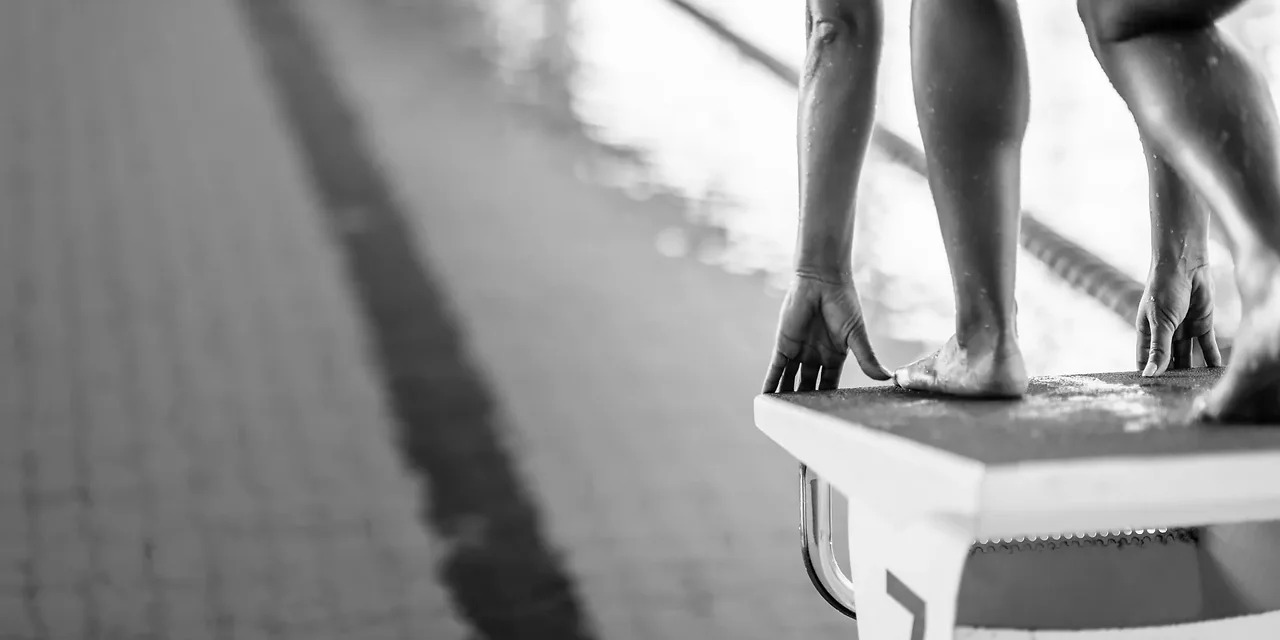
I lost a state championship by less than a yard of water.
It was the 100-yard freestyle, the purest sprint in swimming. Four lengths of the pool, about fifty seconds of churning, and no room for mistakes. When I touched the wall and looked up at the board, I was sixth in the state. The winner was so close I could have reached out and grabbed his shoulder in the last few strokes.
I had been swimming competitively since I was eight. By eighteen I had spent ten years staring at a black line on the bottom of a pool. I loved it. I loved the smell of chlorine, the early mornings, the team. But if I'm honest, I was not built for it. I stood 5'11" with size 9 feet and hands that were, at best, average. Elite sprinters tend to look like they were assembled in a lab: long arms, huge hands, feet like swim fins. I looked like a kid who swam a lot.
And I did swim a lot. I showed up. I did every workout my coach put on the board. But that's the important part, and it took me years to see it: I did the workouts my coach put on the board. Not more. I was a good, obedient, hard-working swimmer who did exactly what was asked.
Then, in tenth grade, my swim coach suggested I go out for track in the off-season. I think he figured I'd run some laps and stay in shape for the pool. Instead, I wandered over to a corner of the field where a few kids were sprinting down a runway with long fiberglass poles, planting them in a box, and flinging themselves upside down over a bar.
Something lit up in me that had never lit up in the pool.
Within a year I was doing far more than any coach assigned. I did extra workouts. I went to camps. I sought out additional coaching. I spent my own money on poles and spikes. I traveled anywhere I could find someone who knew the event and could teach it. I built my own indoor runway so I could vault year-round, because in winter the outdoor runway was not an option. I thought about pole vaulting in class, at dinner, and in bed at night.
Here's how it played out. I qualified for state my first year. I won state my second year. I broke the state record my third year. I became an All-American, and I carried that passion, and an athletic scholarship, into college.
Was I more naturally suited to pole vaulting than to swimming? Probably. A sprinter's speed and a gymnast's comfort upside down help, and I had some of both. But talent alone doesn't explain the gap between "sixth in state after ten years" and "state record holder after three." What changed was not my body. What changed was what was going on inside me.
I've spent the rest of my life, first as a science teacher and track coach and now as a pole vault coach, watching that same pattern repeat. And recently I came across an old Reddit thread that asked the question in its simplest form.
The Question the Internet Keeps Asking
On r/TrueAskReddit, a user posted a deceptively simple question: What is better, talent or passion?
The premise was one most coaches would nod along to. Talent gives you a head start. Passion eventually wins out.
That idea shows up everywhere once you start looking. It's in motivational posts, locker-room posters, and forum threads about harp playing, real estate, and software careers. One Reddit commenter in a different thread put it in a way I wish I'd written myself: when people say they wish they had your talent, what they usually mean is they wish they had your passion, the kind that makes you do something over and over until you're good.
But not everyone agrees, and the dissent is worth hearing.
Computer scientist and author Cal Newport built a whole book, So Good They Can't Ignore You, around the opposite idea. His argument, roughly: "follow your passion" is bad advice, because passion usually comes after you get good at something, not before. Get skilled first, and the love follows. A parent who wrote about his son's tennis struggles framed it as a showdown between Newport and psychologist Angela Duckworth: should a kid chase the thing he's naturally good at, or the thing he can't stop doing? (Jia Jiang)
Others go further and say talent is the one that actually pays the rent. Passion is thrilling and fickle; talent shows up and delivers.
So who's right?
Here's the thing. Both camps are describing something real. And when I hold my own story up against theirs, I notice that Newport's idea and mine aren't as far apart as they look. I didn't love pole vaulting because I was already good at it. But the moment I started improving, fast, the love and the improvement began feeding each other. Passion made me practice more, practice made me better, getting better made me more passionate. That loop is the engine.
The research, it turns out, has a lot to say about that engine. And some of it surprised me.
Talent Is Real. It's Just a Terrible Fortune Teller.
Let me be clear up front, because coaches sometimes get carried away with the "hard work beats everything" speech: talent matters. Anyone who has stood next to a 6'5" high jumper with a 38-inch vertical knows it matters.
The science backs this up from an unexpected direction. For years, the popular story was that practice explains nearly everything. Put in your 10,000 hours and you can become world-class at anything. Then psychologists Brooke Macnamara, David Hambrick, and Frederick Oswald pooled 88 studies covering more than 11,000 people. They found that deliberate practice explained about 26% of the differences in performance in games, 21% in music, and just 18% in sports. (Psychological Science, 2014)
In 2016, Macnamara's team zoomed in on sports alone. Overall, practice still explained about 18% of the differences between athletes. But among elite athletes, those competing at national, international, and Olympic levels, it explained about 1%. (BPS Research Digest)
That makes sense to anyone who has coached. At the top level, everybody trains hard. Hours stop being the separator. Bodies, nervous systems, and something harder to measure take over.
So talent wins, right?
Not so fast. Because here's the twist: early talent is a lousy predictor of who ends up at the top.
German sport scientist Arne Güllich has spent years tracking what happens to youth stars. At a 2016 youth athlete development conference, he told the audience that success at age 10, at 11–14, and at 15–18 had essentially a zero correlation with success as a senior athlete. (Red Sports)
In a later meta-analysis, Güllich, Macnamara, and Hambrick compared world-class adult athletes with national-class ones. The world-class athletes had typically started their main sport later, logged less sport-specific practice as kids, played more other sports, and progressed more gradually. (APS Observer)
A 2023 study by Güllich and colleagues put it bluntly: successful junior athletes and successful senior athletes are largely two different groups of people. Most junior stars never reach the same level as adults, and most adult stars weren't stars as juniors. (Sports Medicine) A more recent review in Science, covering more than 34,000 top performers in sport, chess, music, and academia, found the same pattern across fields. In one set of numbers, 82% of international-level junior athletes did not become international-level seniors, and 72% of international seniors had never reached that level as juniors. (New Scientist, Rutgers Youth Sports)
Read that again with my swimming career in mind. I started at eight. I specialized. I did a decade of yardage. I was a respectable early performer who plateaued. Then I picked up an entirely new sport at fifteen with a body full of transferable athleticism, a late start, and a fire I'd never felt. The research doesn't say that path is guaranteed. But it says it's far more common among eventual champions than most parents and coaches assume.
Back in 1985, educational psychologist Benjamin Bloom studied 120 world-class performers, including 21 Olympic swimmers and 18 top-ten tennis players. He expected to find child prodigies. Mostly, he didn't. What he found instead was a long process: a fun, playful start, then a serious phase with a demanding coach, then a commitment that became part of who they were. Bloom stressed that talented kids need a long-term commitment and a growing passion if their early promise is going to amount to anything. (Encyclopedia of Sport and Exercise Psychology)
So talent is real. But early talent, the kind that wins the 12-and-under meet, tells you surprisingly little about who will still be standing at 22.
What Passion Actually Does
If talent is the head start, what exactly is passion doing during the rest of the race?
It makes you show up for the extra rep
Canadian psychologist Robert Vallerand has studied passion for over two decades. In one of his best-known studies, his team followed 184 high school basketball players. Passion, it turned out, didn't make players better directly. It made them do more deliberate practice, and the practice made them better. A second study with synchronized swimmers and water polo players found the same chain: passion led to practice, and practice led to performance. (Vallerand et al., 2008)
That's exactly what happened to me. In the pool, I did what was on the board. On the runway, nobody had to write anything on a board. I built a runway in a building so I could vault in January. Passion didn't give me a better body. It gave me thousands of extra jumps.
It keeps you there when it hurts
In her famous TED talk on grit, Angela Duckworth tells the story of West Point's Beast Barracks, the brutal summer that welcomes new cadets. West Point already had an elaborate "Whole Candidate Score" built from grades, test scores, fitness, and leadership. Yet a simple 12-item questionnaire measuring grit, which she defines as passion and perseverance for long-term goals, did a better job predicting who would survive Beast. (The Marginalian)
Later, Duckworth and colleagues tracked more than 11,000 cadets over a decade. Grit was a stronger predictor of making it through Beast than cognitive or physical ability. (APA) Talent, in other words, got the cadets admitted. Something else got them through the hardest weeks.
Now, in fairness, grit has its critics, and a research-based article should say so. In 2017, Marcus Credé and colleagues analyzed 88 samples covering nearly 67,000 people. They concluded that grit was only moderately related to performance and overlapped heavily with conscientiousness, plain old diligence. But here's the detail that matters for this argument: the perseverance half of grit predicted results better than the consistency of interest half. (Credé et al., via Scott Barry Kaufman)
In plain terms: the questionnaire may be overhyped, but the behavior, continuing to work when it gets hard, is the part that counts. That's the part passion fuels.
Not all passion is the same
Vallerand's biggest contribution is the idea that passion comes in two flavors.
- Harmonious passion is when you love the sport freely. It's a big part of who you are, but it doesn't own you.
- Obsessive passion is when you feel you have to do it. Your self-worth rides on it. You feel guilty or anxious when you're not doing it.
Both types drive practice. But they take you to very different places. Harmonious passion is linked to mastery goals, well-being, and lower anxiety, with athletes leaning on approach-based coping. Obsessive passion is tied to more anxiety and avoidance coping. (IJSP) In elite junior soccer players, harmonious passion was linked with less burnout, while obsessive passion offered no such protection. (Psychology of Sport and Exercise) Among college athletes, obsessive passion was even associated with more permissive attitudes toward performance-enhancing drugs. (Journal of Intercollegiate Sport)
Vallerand's team summed it up this way: there are two roads to high performance, but only the harmonious one reliably leads to both excellence and a happy life.
When I think back to building that indoor runway, I don't remember feeling driven by fear. I remember feeling lucky. I couldn't believe I'd found something this much fun. That's the kind of passion I try to protect in my athletes today.
Why the Gifted Kid Quits
Every coach has a version of this athlete. Let's call him the natural.
The natural shows up as a freshman and clears heights it took everyone else two years to reach. He barely listens during drills, and why would he? It's working. He wins the conference meet. Everyone tells him how gifted he is.
Then, sometime around junior year, the wall arrives. Maybe it's a growth spurt that scrambles his timing. Maybe it's moving up to a bigger pole that throws him back instead of forward. Maybe it's a new kid from another school who is just as gifted and also works. For the first time, he no-heights at a meet he expected to win.
And the natural, who never had to learn how to struggle, doesn't know what to do with it. Often he quits. Or he stays on the team in body and checks out in spirit.
I've watched this happen more times than I can count. And in sport, I'll say it plainly: things eventually get difficult for everyone. Everyone. The only question is what you've built by the time they do.
The praise trap
Psychologists Claudia Mueller and Carol Dweck, then at Columbia University, ran a series of six studies with fifth graders that every parent and coach should know about. Kids solved a set of puzzles and did well. Some were then praised for being smart. Others were praised for working hard.
Next, the kids got a set of problems that were much harder, and most of them struggled. The kids praised for intelligence enjoyed the task less, persisted less, and were more likely to blame failure on a lack of ability. When given a choice of what to do next, they tended to pick easier problems that would keep them looking smart. The effort-praised kids leaned toward harder problems they could learn from. (Mueller & Dweck, 1998)
Dweck later wrote that praising intelligence gives kids a short burst of pride, followed by a long string of negative consequences. (Educational Leadership) (Growth-mindset research has had its own share of replication debates since then, but this early finding about praise has held up reasonably well.)
Now picture the natural. He's been hearing "you're so gifted" for years. Without anyone meaning to, we've taught him that his identity is his talent. So when he hits a wall, it doesn't feel like a problem to solve. It feels like evidence that he was never special after all. Walking away protects the story.
The passionate kid has a different story. She's not there because she's gifted. She's there because she loves it. A bad meet is just a bad meet. The love is still there on Monday.
Talent needs a rocky road
British researchers Dave Collins and Áine MacNamara study how elite athletes develop. Their now-famous claim is that "talent needs trauma," meaning challenge, not tragedy. In their view, athletes need setbacks, deselection, and tough transitions to develop the skills they'll need at the top, as long as those challenges are supported and debriefed. (Collins & MacNamara, 2012)
When they interviewed 54 athletes, grouped as "super-champions," "champions," and "almosts," they found something revealing. The almosts didn't have an easier road. If anything, the almosts reported more trauma than the super-champions. (Collins, MacNamara & McCarthy, 2016) What separated the groups was less about how many hard things happened and more about how the athletes met them and what they did next. (Frontiers in Psychology)
That matches what I see on the runway. The athletes who make it aren't the ones who avoided the wall. They're the ones who had a reason to climb it.
What I Tell Athletes (and Their Parents) Now
So, talent or passion?
After a lifetime around pools and runways, and after digging through the research, here's my honest answer: talent decides how fast you start. Passion decides how long you keep going. And in sport, how long you keep going decides almost everything.
Talent is real, and pretending otherwise does athletes no favors. But early talent is a weak predictor, and talent without a reason to keep working tends to stall the first time the road gets steep. Passion, the healthy kind, is what turns talent into thousands of extra reps, and it's what keeps an athlete at the wall long enough to find the way over it.
Here's what that looks like in practice.
- Don't crown kids early. The research on junior versus senior success should humble every coach and parent. The 12-year-old winning everything is not necessarily your future champion, and the late bloomer you're ignoring might be.
- Let them sample. World-class adults tended to play more sports as kids, not fewer. My ten years in the pool weren't wasted. They built the engine I brought to the runway.
- Praise the work, not the gift. "You're a natural" sounds kind. "You figured out that takeoff because you kept adjusting your step" is far more useful.
- Watch for what they do unassigned. The strongest signal of passion I know isn't what an athlete says. It's what they do when nobody's asking. The extra drill. The video they studied at midnight. The question after practice.
- Protect the joy. Steer passion toward the harmonious kind: loving the sport, not needing it to feel worthy. Obsession can produce results for a while. Harmony produces results and a life.
- Expect the wall, and prepare them for it. Hard times are coming for everyone. Our job isn't to remove them. It's to make sure athletes have the skills, support, and reason to climb when they arrive.
Back to that last yard
I still think about that 100-yard race sometimes. Less than a yard. About the length of an arm.
I used to think about it as the race I almost won. Now I think of it differently. It was the clearest picture I ever got of what talent plus obedience can produce: a solid, respectable, sixth-place finish.
What I didn't have in the pool was the thing that showed up on the runway. The thing that made me build my own facility, chase down coaches, spend my own money, and lie awake thinking about plant angles. That was the difference between sixth place and a state record.
Over the years I've coached a lot of athletes who, on paper, weren't supposed to go very far. A lot of them proved me wrong. They didn't do it because they were secretly more gifted than I thought. They did it because they cared more than anyone could have measured.
Talent gets you started. Passion gets you there.
Sources
- Reddit, r/TrueAskReddit: What is better, talent or passion?
- Macnamara, Hambrick & Oswald (2014), deliberate practice meta-analysis: EurekAlert summary
- Macnamara, Moreau & Hambrick (2016), deliberate practice in sports: BPS Research Digest
- Güllich, Macnamara & Hambrick (2021), What makes a champion?: APS Observer
- Güllich et al. (2023), junior vs. senior success: Sports Medicine
- Güllich, 2016 Youth Athlete Development Conference: Red Sports
- Güllich et al., review of 34,000+ top performers in Science: New Scientist, Rutgers Youth Sports Research Council
- Bloom (1985), Developing Talent in Young People: Encyclopedia of Sport and Exercise Psychology
- Vallerand et al. (2008), passion and performance attainment in sport: PDF
- Passion, coping, and anxiety in sport: International Journal of Sport Psychology
- Passion and burnout in elite junior soccer players: Psychology of Sport and Exercise
- Passion and attitudes toward PEDs: Journal of Intercollegiate Sport
- Duckworth, TED talk transcript: The Singju Post
- Duckworth & West Point: The Marginalian, APA
- Credé, Tynan & Harms (2017), grit meta-analysis: Scott Barry Kaufman summary
- Mueller & Dweck (1998), praise for intelligence: PDF
- Dweck, The Perils and Promises of Praise: PDF
- Collins & MacNamara (2012), The rocky road to the top: UCLan
- Collins, MacNamara & McCarthy (2016), Super champions, champions, and almosts: Frontiers in Psychology, follow-up
- Talent vs. passion debate, Duckworth vs. Newport: Jia Jiang
Related articles
The Other Bird: What Separated Good from Great
Same town, same coach, same backyard court. Eddie Bird broke his famous brother’s high school scoring record, then spent his career living in Larry’s shadow. Drawing on 1980s reporting and research on talent, passion and pressure, this is a look at what really separates good from great, and what coaches and parents can do about it.
Late Start, Fast Finish: Getting Sprinters and Jumpers Competition-Ready in a Hurry
Missed the off-season and the first meet is only weeks away? For sprinters, hurdlers and jumpers, the research points to short, fully rested sprints, heavy but brief lifting, plyometrics and a real taper, not punishing conditioning. Here’s what works, what’s a waste of time, and a 6- and 8-week plan to get you there safely.
The Hidden Engine of Top Speed: Why Sprinters Can't Ignore the Soleus
When scientists put 33 runners on a force-plate treadmill, they expected the fastest ones to have the quickest legs. Instead, everyone repositioned their legs in about the same time. The fastest runners simply hit the ground harder. The muscle that takes that hit, at several times body weight every step, is one most athletes never train: the soleus.