
How to Jump Higher: What Actually Works
Here’s the research-backed way to add inches to your vertical.
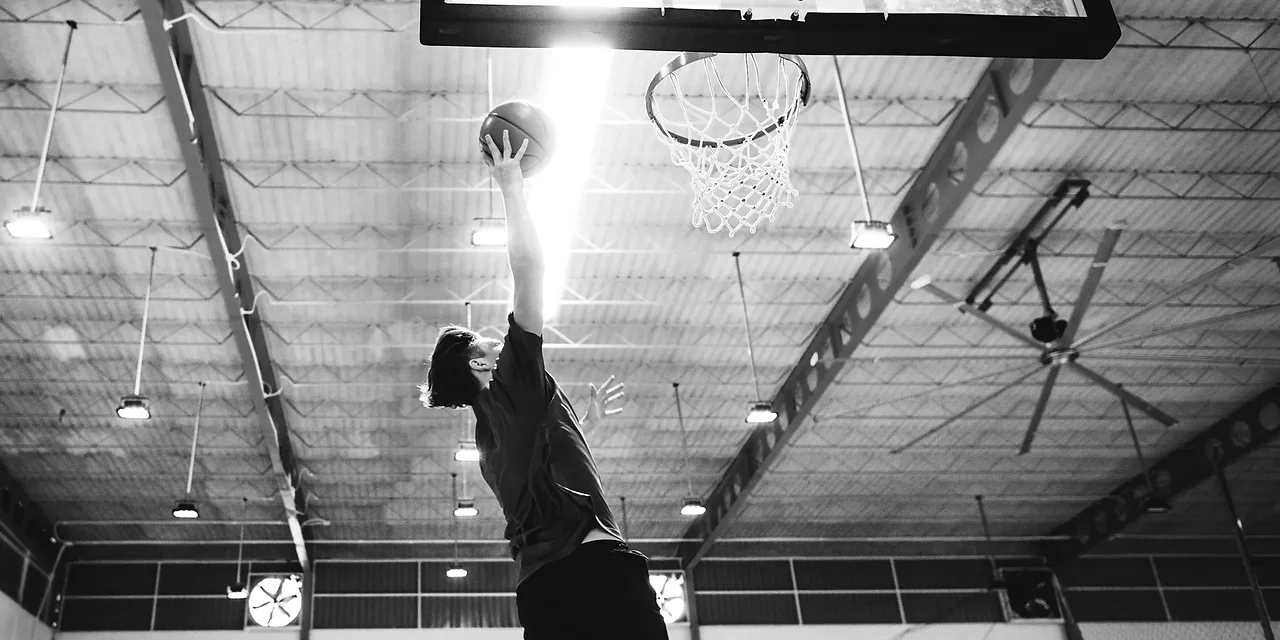
In February 1986, a 22-year-old rookie walked onto the court for the NBA Slam Dunk Contest in Dallas, his hometown. He stood 5-foot-7 and weighed about 135 pounds. Some of the men he was up against were more than a foot taller. His own teammate, defending champion Dominique Wilkins, had never even seen him try a dunk.
Spud Webb won. In the final round he put up two perfect 50s. Forty years later, he's still the shortest player ever to win it.
Webb couldn't change his height. He changed what his legs could do with it.
So can you. Your vertical jump isn't a gift you got or didn't get. It's a skill, and it grows with the right work. Here's what actually works, minus the gimmicks.
A jump is decided in a split second
Every vertical jump comes down to one number: how fast you're moving upward the instant your feet leave the ground. After that, gravity takes over. Nothing you do in the air adds an inch.
Here's the fun part. Jump height grows with the square of that takeoff speed. Leave the ground 10% faster, and you go about 21% higher. Small gains in power turn into big gains in height.
To leave the ground faster, you need three things:
- Strength. The engine. How much force your legs can produce.
- Speed. How fast you can drive that force into the ground. You only get a fraction of a second.
- Skill. Using your arms, your dip and your approach so none of that force leaks away.
And one quiet factor: what you're carrying. Every extra pound is one more pound your legs have to launch.
Step one: build a bigger engine
You can't put force into the ground that your legs can't make. That's why strong legs and big jumps tend to travel together.
In one study of trained athletes, back squat strength and countermovement jump height were strongly linked (r = 0.76, where 1.0 would be a perfect match). Another study found that strength relative to body weight also predicted how high people jumped. And a 2022 review of 34 studies found that Olympic-style lifts combined with regular strength training improved jump height, sprint times and squat strength.
What to do, twice a week:
- Squat. Back or front squat, 3 to 5 sets of 3 to 6 reps. Heavy, but every rep clean.
- Hinge. Trap-bar deadlifts or Romanian deadlifts.
- One leg at a time. Split squats or step-ups. Jumping and landing often happen on one leg.
- Power lifts, if you're coached. Hang cleans or power cleans teach you to be strong and fast.
If you're new to lifting, here's the good news: you have the most room to grow. Just getting strong will move your vertical before you do anything fancy.
Step two: teach the engine to fire fast
Plyometrics are jumps, hops and bounds that train your legs to stretch and snap back like a spring. They work, and the research is clear about it.
A review of 26 studies found plyometric training raised countermovement jump height by about 8.7% on average. On a 20-inch vertical, that's close to two inches, from jumping smarter. A later review found the best results came from programs lasting 8 to 12 weeks.
The best picks, from easiest to hardest:
- Pogo hops. Quick, bouncy hops off the balls of your feet with stiff ankles. Fast off the ground is the goal.
- Box jumps. Jump up, then step down. Stepping down saves your legs for the next rep.
- Max-height jumps. One big countermovement jump, full rest, repeat.
- Broad jumps. Jump forward as far as you can and stick the landing.
- Depth jumps. Step off a low box and explode upward the instant you land. Save these until you're strong and land well.
The golden rule: every rep is a max effort. Plyometrics train speed, and tired legs are slow legs. Rest between sets, and stop when your jumps start getting lower. Fewer great jumps beat lots of sloppy ones.
Step three: grab the free inches
Some of your vertical is already there. You're just not using it yet.
Swing your arms. This one is huge. In one study, a good arm swing added about 3 inches to the average jump. Elite volleyball players jumped 38% higher with an arm swing than with their hands kept still. Swing your arms back as you dip, then drive them up hard as you push off.
Use the dip. A quick down-and-up stores elastic energy in your muscles and tendons, like loading a spring. Don't sink too deep or pause at the bottom. Down fast, up faster.
Take a run at it. Most athletes jump higher off a short approach than from a standstill. Two or three quick steps, a longer second-to-last step, plant both feet, and go. Watch old footage of Webb: much of his magic came from how fast he got to the rim.
Practice the jump your sport uses. A basketball player needs approach jumps. A volleyball blocker needs quick jumps from a standstill. A high jumper or pole vaulter needs a one-foot takeoff at speed. Train the version you'll use.
The boring stuff that makes it all work
Nobody posts highlight videos of sleep. But this is where the inches get locked in.
- Give it time. Expect real change over 8 to 12 weeks, not 8 to 12 days. In a review of female athletes, plyometric programs longer than 10 weeks had a much larger effect on jump height than shorter ones.
- Jump fresh. Do jump work at the start of a session, after a warm-up, never after a hard run or a heavy leg day. Leave about two days between hard jumping sessions.
- Sleep and eat. Muscles rebuild and your nervous system adapts while you rest, not while you train.
- Lose fat, keep muscle. Same force, lighter body, higher jump. It's simple physics.
- Land like a cat. Soft landings, knees in line with your toes. Done well, plyometric training also helps prevent knee injuries in female athletes.
Your 8-week plan
Two sessions a week, with at least two days between them. Jump first, lift second. Warm up for 10 minutes before every session.
Weeks | Jumps (do first) | Strength (do second) | Test |
|---|---|---|---|
1–2: Foundation | Pogo hops 3×15 · box jumps 4×5 · practice your arm swing and dip | Squat 3×8 · Romanian deadlift 3×8 · split squat 2×8 per leg | Test your vertical on day 1 |
3–5: Build | Max-height jumps 5×3 · broad jumps 4×3 · box jumps 3×5 | Squat 4×5 · trap-bar deadlift 3×5 · step-ups 3×6 per leg | Retest at the end of week 4 |
6–8: Peak | Approach jumps 6×2 · depth jumps from a low box 3×4 (only if landing well) · max-height jumps 3×3 | Squat 5×3, heavy · hang clean 4×3 (if coached) · split squat 2×6 per leg | Final test after 2–3 easy days |
Rest about 1 to 2 minutes between jump sets and 2 to 3 minutes between heavy lifting sets. If your jumps get lower or your form gets sloppy, stop for the day. That's not quitting. That's training smart.
Young athletes and beginners: learn the lifts from a qualified coach first, and keep the weights light until your form is solid.
Skip the gimmicks
The internet is full of shortcuts. Here's what to skip.
- "Add 10 inches in 2 weeks!" Real programs in real studies show average gains of roughly 5 to 9 percent over several weeks. That's a great result. Ten inches in two weeks is a sales pitch.
- Hundreds of jumps a day. Tired jumping trains you to be slow. Quality wins.
- Endless calf raises. Your calves help, but your hips and thighs do most of the work. Squat first.
- Jumping in ankle weights. It changes how you move and loads your joints in awkward ways. Get strong with real lifts instead.
- Waiting to "feel ready." You won't. Start with week one and let the work make you ready.
Measure it, or it didn't happen
You can't improve what you don't measure. Test your vertical the same way every time: same wall or app, same warm-up, best of three tries. Free phone apps can measure jump height from video, and one, My Jump 3, has been checked against lab methods.
Write down every test. Write down your squat, too. Watching both numbers climb is the best motivation there is. It's also why we built AthleticPeak Pro to keep every test and every session in one record you own.
Your turn
Nobody handed Spud Webb a taller body. He made the most of the one he had, and a building full of people chanted his name for it.
Your vertical isn't a fixed number. It's a record you haven't broken yet. Test it today. Then start week one.
Sources
- AJC: Spud Webb and Dominique Wilkins reflect on the 1986 dunk contest
- SLAM: Spud Webb interview
- HISTORY: Spud Webb wins the 1986 dunk contest
- Markovic (2007): Does plyometric training improve vertical jump height? A meta-analysis
- Kumar & Dhull (2023): Optimal duration of plyometric training for vertical jump
- Stojanović et al. (2017): Plyometric training and vertical jump in female athletes
- Ștef & Grosu (2020): Maximum strength and vertical jump in junior speed skaters
- Predicting jump height from absolute and relative leg strength
- Weightlifting training and jumping ability: a meta-analysis (2022)
- Kinetic contributions of the arms in the vertical jump
- Vaverka et al. (2016): Arm swing and vertical jump in elite volleyball players
- Deva & Berisha: Arm technique, elastic force, and the My Jump 3 app
Related articles
How to Get Faster: What Sprint Coaches Agree Actually Works
Getting faster isn’t complicated. Sprint short, at full effort, with full rest. Here’s what works, what to skip, and how to plan it across a season.
Rest Days Are Where The Adaptation Happens
Smolov is famous for the workload, but the gains are built on the days you do not lift. Protect your rest and you protect your progress.