
Give Yourself a Reason
Purpose rarely arrives on its own.
I used to teach high school science in Alaska — sometimes in classrooms where the wind slammed against the windows, making the students shiver as if the cold had reached right through the walls. And in those rooms, year after year, I watched the same pattern emerge: smart, capable teenagers who passed their tests, turned in their homework, earned their credits, yet still seemed unsure of what came next. Many of them were waiting. Waiting for inspiration. Waiting for meaning. Waiting for someone — or something — to tell them what their lives should become.
It’s a quiet kind of heartbreak.
They thought life would eventually hand them a purpose. But purpose rarely shows up at your doorstep.
They were bright. Curious. Capable. They completed what was asked of them, did well enough in class, and moved steadily toward graduation. But beneath the surface, I saw a quiet uncertainty. They were waiting for inspiration to strike, as if purpose might someday arrive like a text message: clear, convenient, undeniable. Some waited for teachers to tell them what they should want. Others waited for the world to reveal a passion they hadn’t tried yet. A few waited so long that waiting itself became a habit—safe, familiar, almost comforting.
“The future can no longer be What is going to happen? It is What are we going to do?” - Henri Bergson.
The trouble is that you can spend your first thousand weeks waiting without realizing it. And life is short — you only get about 4,000 weeks if you live to 80.
So many drift through those early years as passive observers. They watch others create, build, compete, and explore. They watch from the couch, from their phones, through someone else’s camera lens. Screens can trick you into feeling involved when you haven’t actually touched anything real.
I have lived in Alaska for over 30 years, where waiting is rarely a winning strategy. The snow doesn’t care about your plans. The roof won’t shovel itself. Cold doesn’t negotiate. The environment teaches a simple truth: motion matters. Even imperfect motion. Even uncertain motion. Even the kind that starts with a deep breath and the quiet hope that you’ll figure it out as you go.
This mindset shaped the way I taught. I began encouraging my students to try everything. Not because I believed that ballroom dancing, welding, building birdhouses, or joining the cross-country team would magically reveal their destiny, but because trying something breaks the spell of passivity. It gets them out of their heads and into the world. And the world has a way of answering questions you cannot think yourself through.
I told them to experiment.
To join a club they knew nothing about. To volunteer even if they felt shy. To write, to build, to run, to create, to mess up, to laugh about the mess, and to do it again. None of this required talent. It only required willingness to begin.
Some kids jumped in immediately. Others hesitated, afraid of looking foolish. But once they tried something—anything—they learned they could survive the discomfort of being a beginner. And once they knew that, they began discovering pieces of themselves that had been waiting all along.
That same lesson threaded through my own life more than once. When I was young, I chased the Olympic dream in the pole vault. I reached the qualifying mark for the 1992 Olympics—earning the status of an Olympic hopeful—but I still fell short of making the team. For a while, that loss felt heavy, like a door closing. But failures have a strange way of becoming beginnings.
That disappointment nudged me toward coaching, first with local athletes, then with my own kids. I watched them grow into college vaulters—gritty, determined, and braver than they realized. Later, those years on the track pushed me to write a book for young athletes searching for direction. None of that would have happened without the leap I took decades earlier, when I didn’t know what would come of it.
I saw the same pattern during my years teaching in the Arctic. Opportunities appeared disguised as inconveniences: a last-minute flight to a village I had never visited, a snowstorm that left me sleeping on the floor of a classroom, a long evening spent planning lessons with elders who were determined to help their youth succeed. These unexpected chapters shaped me more than any plan could have. They reminded me again that life often rewards the people who show up, even when they don’t feel ready.
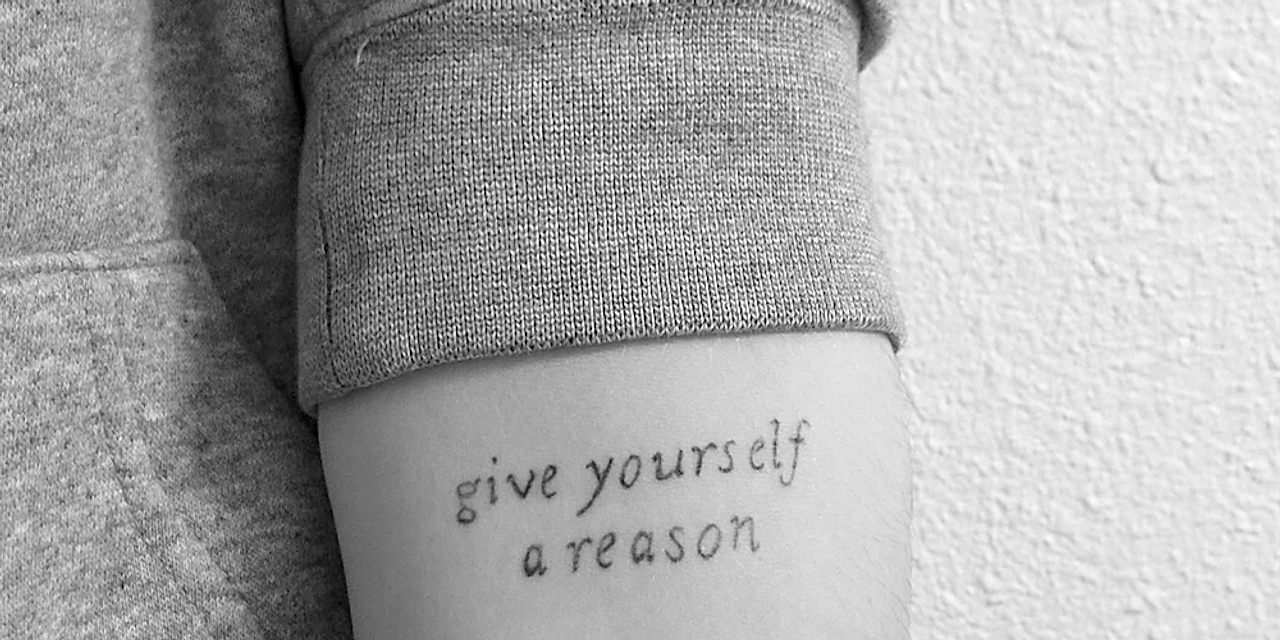
Of everything I’ve learned, nothing surprised me—or humbled me—more than the moment my daughter took this philosophy and made it her own. One day she lifted her sleeve and showed me four small words inked on her arm:
Give yourself a reason.
I’ll admit, my first reaction was the typical parent’s mix of shock and concern. But that faded quickly, because those words captured a lifetime of teaching, coaching, parenting, and failing forward. They distilled everything I had been trying to tell my students, everything I had learned from my own missteps, and everything I hoped my kids would carry into their lives.
Her tattoo is the picture at the top of this article for a reason. It’s a reminder that meaning does not arrive on its own. You must open the door.
And so, if you are someone who has been waiting—for clarity, for confidence, for confirmation that you’re ready—this is your nudge.
Try something.
Anything.
You don’t need certainty to begin. You only need a reason.
And you can give yourself one today.
Related articles
The Miler Who Matched My Bench Press: Why Middle-Distance Runners Should Lift
Distance runners aren’t weak. The research shows that heavy lifting makes 800 m–3200 m runners more economical, faster at the kick, and less likely to be injured.
Why Fueling Beats a Number on the Scale
How eating the "perfect" diet cost me 11 pounds of power in an Olympic year, and why sprinters, jumpers, and vaulters should fuel for power, not a number on the scale.
The question every masters athlete eventually asks
Weight loss, squats, deadlifts, running, supplements: which ones actually make an athlete over 40 faster, springier, and more athletic? We read the research, the coaches, the forums, and the record holders.